From an engineering perspective, “what is the meaning of ground mounted solar?” refers to a power generation system in which photovoltaic modules are installed directly on ground-mounted racks.
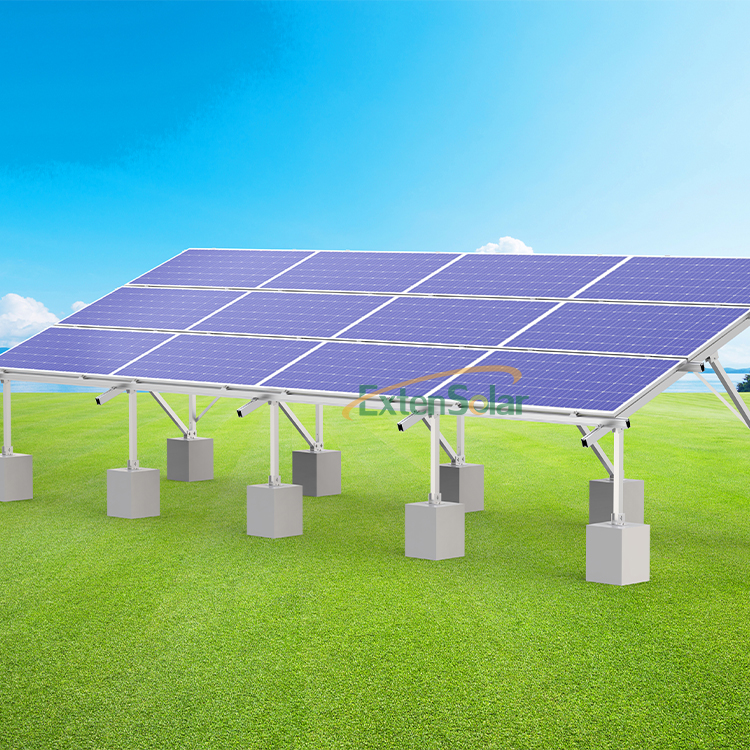
It represents a completely different application scenario from the rooftop solar systems we commonly see. Rooftop solar is constrained by building orientation, load-bearing capacity, and shading, whereas the core principle of ground-mounted solar is to place the photovoltaic array in the most open and suitable location, allowing the modules to maximize their absorption of solar radiation.
In the domestic power market, when we discuss “what is the meaning of ground mounted solar?” we typically refer to centralized ground-mounted power plants of 10 MW or larger. Such projects are generally built in deserts, mountainous areas, or tidal flats, and the electricity they generate is fed directly into the State Grid at 110 kV or higher voltage levels after being inverted and stepped up. Its core advantages are clear: large scale, low cost per unit, and centralized operations and maintenance.
Under the same solar irradiation conditions, the cost per kilowatt-hour for ground-mounted power plants is typically 15%–20% lower than that of distributed projects, which is the fundamental reason why they have become the preferred solution for large domestic power groups. It can be said that understanding the meaning of ground mounted solar is equivalent to understanding the primary roadmap for achieving grid parity in China’s photovoltaic sector.
What are the mainstream types of ground mounted solar systems?
When classified by the movement of the mounting structure, ground mounted solar systems are primarily divided into two categories: fixed and tracking.
Fixed systems are straightforward—solar panels are installed at a fixed, optimal tilt angle and remain stationary throughout the year. The main benefits of this approach are a simple structure, low initial investment, virtually no moving parts, and minimal maintenance requirements. In China, fixed-mount systems still account for about 25–30% of the ground-mounted power plant market and are particularly suitable for small- and medium-sized projects or in areas where local labor costs are high but land rents are low.
Tracking systems, on the other hand, are more active. They use a drive mechanism to rotate the solar panels from east to west each day as the sun moves. Currently, the most common type is the single-axis tracker—the panels rotate around a horizontal axis, with tracking accuracy sufficient to meet power generation needs. Data from 2026 shows that single-axis tracking systems accounted for 55–60% of new large-scale ground-mounted projects in China, as they can generate 10–15% more electricity than fixed systems. Given the ongoing decline in module prices, this increase in output is sufficient to offset the additional cost of the trackers. There are also dual-axis trackers, which can adjust both the horizontal and tilt angles simultaneously, offering even higher power generation gains. However, due to their complex structure and high cost, they are currently used primarily in research and demonstration projects or in specific regions with exceptionally favorable sunlight conditions.
How to Choose Mounting Structure Materials?
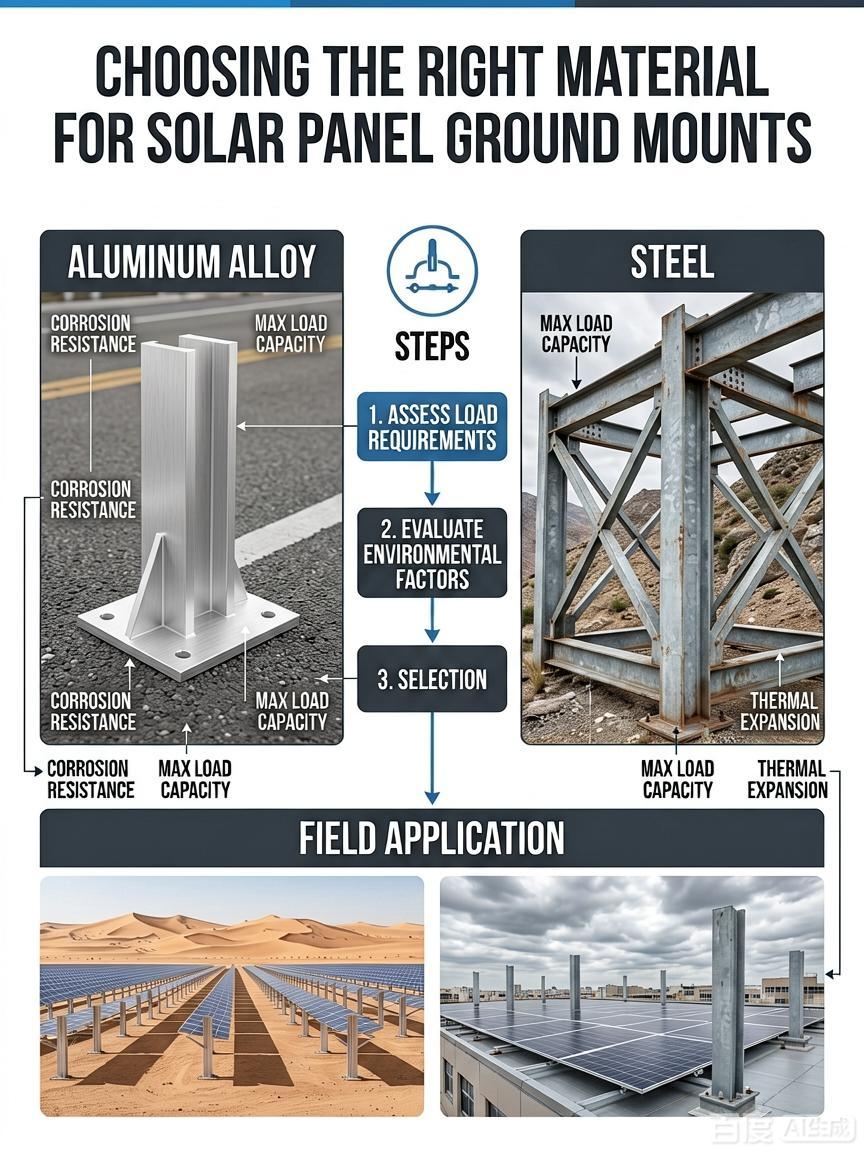
The choice of materials directly affects a project’s initial investment and long-term reliability. Currently, for ground-mounted power plants in China, the decision regarding mounting structure materials generally comes down to steel or aluminum alloy.
The advantage of steel (commonly Q235B hot-dip galvanized steel) is its high strength. Under the same load conditions, steel can achieve the design strength with a smaller cross-sectional dimension and exhibits less deformation. For long-span designs or areas where the basic wind pressure exceeds 0.6 kN/m², steel offers a clear advantage. However, its weakness lies in corrosion protection—the galvanized coating gradually deteriorates in coastal environments with high salt fog or industrial pollution. Typically, the galvanized coating thickness must be no less than 80 μm, and in special environments, it must exceed 100 μm. The design life is generally 20–25 years, during which regular inspections and maintenance are required.
Aluminum alloys (such as 6063 T6) operate on an entirely different principle. Weighing only about 35% as much as steel, they naturally form a dense oxide film on their surface when exposed to the atmosphere, resulting in an extremely low corrosion rate. In coastal projects or high-humidity regions, aluminum alloys require virtually no additional investment in corrosion protection and can retain approximately 65% of their salvage value after 30 years. However, the yield strength of aluminum alloy is approximately 68%–69% that of steel. In areas with strong winds, the cross-sectional dimensions must be increased to compensate for the lower strength, which leads to higher material costs. Empirical data from actual engineering projects shows that under conditions of a basic wind pressure of 0.6 kN/m² and a support span of less than 2 meters, the total cost of aluminum alloy supports is approximately 1.3–1.5 times that of steel.
The decision on material selection is straightforward: for standard sites with moderate wind speeds, steel is more economical; for coastal corrosive environments or sites where structural self-weight is a concern, aluminum alloy offers greater peace of mind.
Does wind resistance require special attention?
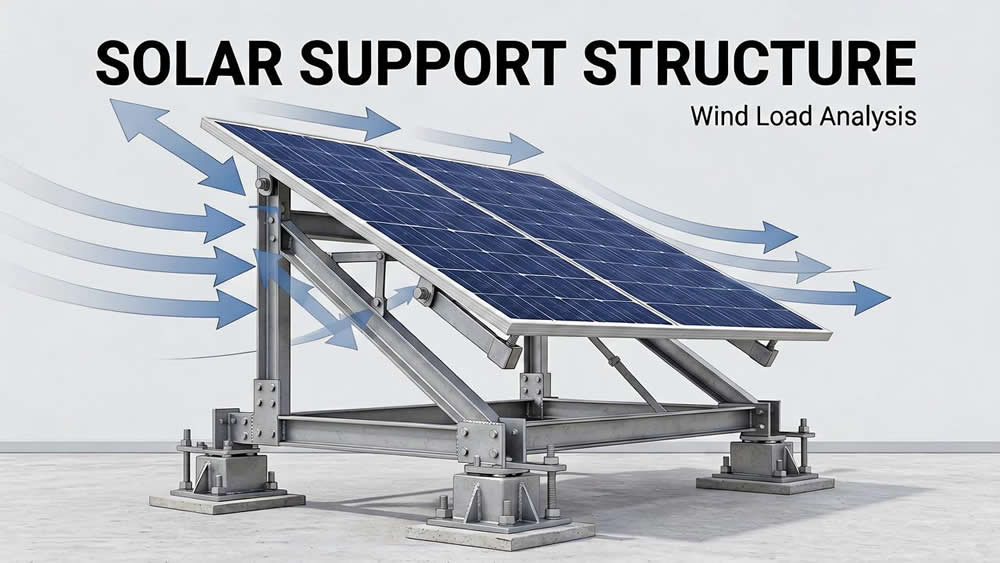
Absolutely. Wind-resistant design is not an option but a mandatory requirement. Domestic design codes for photovoltaic power plants explicitly stipulate that mounting structures must simultaneously meet requirements for strength, stiffness, and overall stability, with wind loads often serving as the decisive factor in design.
In actual projects, wind resistance is ensured on two levels. First is structural analysis—standard wind load values are calculated based on the project site’s basic wind pressure, ground roughness category, and installation height, followed by stress verification for each component and connection node. Second is foundation selection—in high-wind areas, either the weight of concrete ballast blocks must be increased, or screw piles or cast-in-place reinforced concrete pile foundations must be used to provide sufficient uplift resistance and overturning resistance.
For example, in high-wind regions such as Inner Mongolia or Xinjiang, if a concrete ballast solution is adopted, the weight of each individual ballast block must be determined by back-calculating based on the local 50-year return period maximum wind speed; it cannot be estimated based on experience. Steel mounting systems typically exhibit less structural deformation under high-wind conditions than aluminum alloy systems, which is one reason why steel is more highly recommended in high-wind areas. Some power plants have experienced issues—module fasteners (weight blocks or bolts) have torn or loosened under extreme wind conditions, leading to module detachment or hidden cracks. The root cause of these incidents is almost always insufficient safety margins at the connection joints. Therefore, our position is clear: wind resistance is not a matter of “whether or not to pay attention to it,” but rather a fundamental engineering aspect that must be executed thoroughly and with built-in redundancy.
Summary
Ground mounted solar is currently the absolute main driver of PV installation growth in China. It utilizes open land resources to efficiently convert solar energy into electricity and feed it into the grid through large-scale, centralized power plants. Systems are divided into fixed and tracking types, with single-axis trackers rapidly expanding their market share due to their power generation gains. In terms of material selection, steel excels in strength and cost-effectiveness, while aluminum alloy offers superior corrosion resistance and light weight; each has its own suitable applications. Wind resistance design, however, is the essential safety baseline that must be prioritized in all ground-mounted projects—ensuring stable system operation over a 25-year lifecycle through rigorous calculations and appropriate foundation configurations. By mastering these key points, the technical path for ground-mounted solar projects becomes clear.
Common Questions About Ground Mounted Solar
Q1: Which offers a higher return on investment: ground-mounted or rooftop solar?
The economies of scale of ground mounted solar result in lower unit costs, typically 10%–15% lower than rooftop projects. However, ground-mounted projects incur additional costs for land rent and grid connection, and the approval process takes longer. The return on investment depends on project scale and local electricity pricing policies; there is no definitive answer.
Q2: Does the additional electricity generated by single-axis trackers compared to fixed systems cover the extra investment?
Currently, this is the case in most regions of China with good sunlight resources. Single-axis tracking systems are 20–30% more expensive than fixed systems but increase power generation by 10–15%. Based on current module prices and feed-in tariffs, the cost per kilowatt-hour for both is already very close; in provinces with ample sunlight, trackers may even have a slight advantage.
Q3: How many years will the galvanized coating on steel mounting structures last?
In normal atmospheric conditions, an 80-micrometer galvanized coating can ensure no significant rusting for over 20 years. In coastal or industrially polluted areas, it is recommended to increase the coating thickness to 100 micrometers or more and inspect the condition of the galvanized coating every 2–3 years. Aluminum alloy structures are essentially maintenance-free and have a longer corrosion-resistant lifespan than steel.
Q4: What are the minimum geological requirements for ground-mounted PV systems?
First, the site must be open and free of permanent obstructions. Second, the ground must be capable of supporting foundation construction—soft soil or quicksand will significantly increase the workload for pile foundations, while bedrock will make drilling more difficult. The site must also avoid prime farmland, ecological red lines, and cultural heritage protection areas.
Q5: What is the most important consideration when building ground mounted solar systems in typhoon-prone areas?
The key in typhoon-prone areas is wind resistance. Steel should be the preferred material for mounting structures, and the foundation should prioritize cast-in-place concrete piles or deep-buried screw piles, with sufficient burial depth to withstand wind suction forces. All bolted connections must undergo dual treatment for anti-loosening and anti-corrosion. When verifying wind loads, it is recommended to apply a design safety factor of 1.1–1.2 times the values specified in the standards.
Choose Yiteng
Yiteng offers a full range of ground mounted solar mounting systems, from fixed mounts to single-axis trackers. All systems have undergone wind tunnel testing and structural strength verification. Choosing us ensures that your ground-mounted solar project receives reliable technical support and consistent delivery quality, from mounting system design through on-site installation.


