Do all solar panels have the same mountings? Solar panel mounts are not one-size-fits-all. The panel structure, installation location, and local environment collectively determine which mount you should use.
Do all solar panels have the same mountings? No. Not all solar panels use the same mounting system. That’s the short answer. But what truly determines whether a project will proceed smoothly is the more comprehensive answer. Mounting compatibility depends on three factors: the panel’s structure, where you’re installing it, and the local environmental requirements for installation. This article will introduce common mounting types and show you how to choose the right one to avoid mistakes.
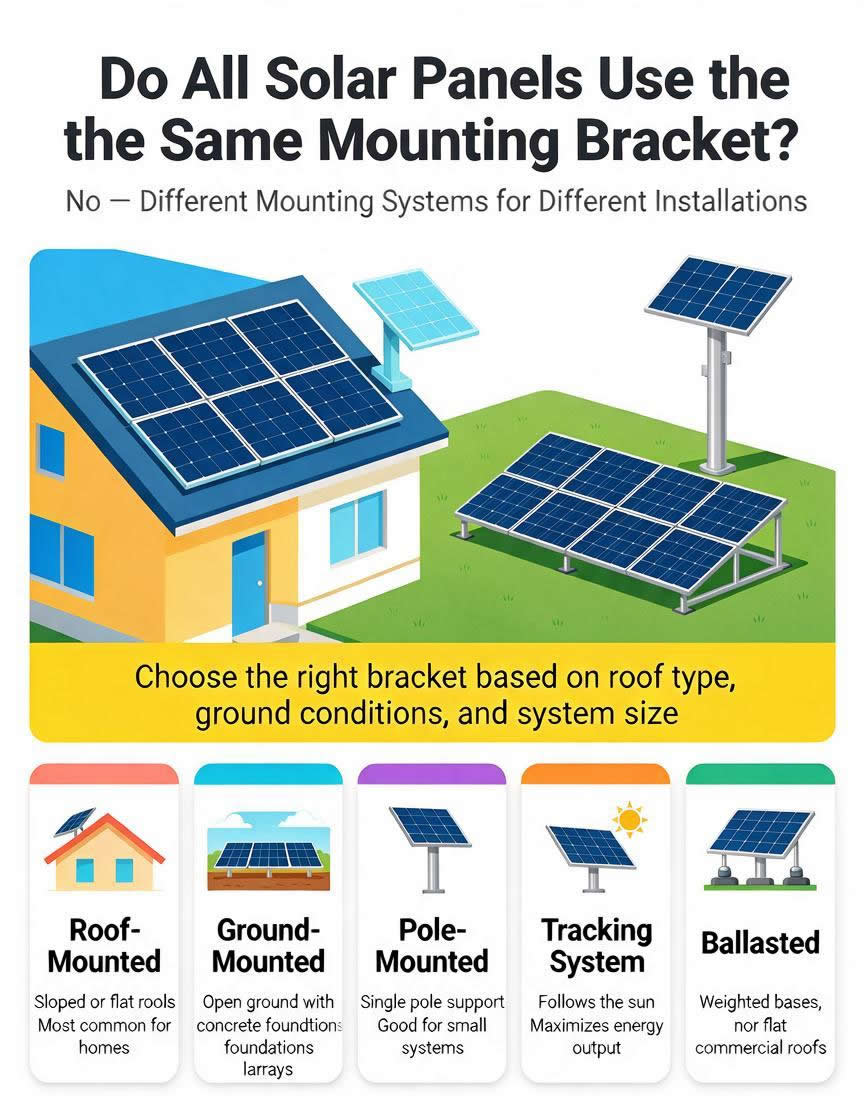
1. Do All Solar Panels Have the Same Mountings?
Standard framed panels are typically secured using rails and clamps. This is the most common method. However, panels that look similar may not necessarily be compatible with the same mounting system. Different models have varying frame shapes, thicknesses, and areas that can be clamped. A clamp that secures one panel may not hold another.
Frameless panels, flexible panels, and thin-film panels present even more unique challenges. They often require specialized clamps or are installed using adhesive. You cannot assume that traditional center and end clamps will work.
It’s important to distinguish between two things: similar mounting types and interchangeable mounts are two entirely different matters.
2. What Determines Solar Panel Mounting Compatibility?
Panel Frame and Thickness
The mounting bracket must match the thickness of the panel frame. If the clamping opening is too wide, the panel will not be secured firmly. If it is too narrow, the panel won’t fit at all. The frame design also affects the mounting method. Some frames have flanges, while others do not. Some are deep, while others are shallow. These details all determine which mounting bracket you should choose.
Panel dimensions and weight
The rail and mounting bracket structure must be able to support the panel’s dimensions and weight. The longer the panel, the greater the stress on the rails. The heavier the panel, the stronger the support structure must be. Similar dimensions do not necessarily mean that the mounting hole positions or clamping areas are the same. Often, they simply do not align.
Manufacturer-approved clamping zones
Most panel manufacturers explicitly specify the permitted clamping locations. These locations are not recommendations—they are mandatory requirements. Clamping outside the permitted areas may damage the panel or void the warranty. In severe cases, it can also pose a safety hazard.
Roof or installation surface
Roof material, slope, and structure determine which fasteners you should use. Tile roofs and metal roofs require completely different mounting methods. Flat roofs typically use ballast-type or tilt-type brackets. Ground-mounted, carport-mounted, and RV-mounted installations each have their own specific support requirements. No single solution works for every scenario.
Local weather and building codes
Wind loads, snow loads, corrosive environments, and local building codes all influence the selection of mounting systems. A solution suitable for low-wind areas may be insufficient in high-wind regions. In coastal environments, corrosion protection must be considered. In areas with high snow loads, the structure must be reinforced. Be sure to check local load requirements and codes before purchasing.
Rail-mounted systems are typically used on sloped roofs. The rails are laid along the roof’s slope, and the panels are secured with clamps. Ballast-mounted or tilted mounts are commonly used on flat roofs. Tile roofs, metal roofs, and asphalt shingle roofs each require different mounting methods. The roof type—not the panel brand—is what truly determines the choice of hardware.
There are several types of ground-mounted systems. Fixed-tilt mounts are the simplest and most common. Single-axis and dual-axis tracking mounts follow the sun’s path, generating more electricity but at a higher cost and with more complex maintenance. The choice depends on site space, budget, and power generation goals.
Pole mounts and solar canopies
Pole mounts are suitable for small-scale installations or projects with unique site conditions. Solar canopies are common in parking lots and commercial projects, providing both shade and electricity generation. These systems have their own structural requirements and cannot be used interchangeably with standard roof mounts.
Flexible and frameless panel mounts
Flexible, frameless, and thin-film panels typically require specialized mounting systems. Don’t assume that traditional center clamps and end clamps will work as a makeshift solution. Many of these panels use adhesive mounting or specialized hardware. Using the wrong mounting system can result in damage to the panels at best, or the entire panel flying off at worst.
Are Solar Panel Mounts Universal?
Some components are indeed fairly standardized. Common rail specifications and certain clamp sizes are interchangeable across different brands. This is a good thing. However, many components are not directly interchangeable. Roof connectors, edge clamps, and special panel mounting hardware are usually tied to specific systems. The safest approach is to cross-reference the specifications from both the panel manufacturer and the mounting system manufacturer. Only when both match can the components be considered truly compatible.
4. How to Check Whether a Mount Fits Your Solar Panels
Locate the panel model number and installation manual.
Confirm the panel’s thickness, dimensions, weight, and permissible clamping area.
Check the mounting system’s compatibility list and clamp specifications.
Verify the structural conditions of the roof or ground, as well as local load requirements.
If you’re unsure, consult a licensed installer or the mounting system manufacturer.
These five steps may seem simple, but they can help you avoid most installation mishaps.
5. What Happens If You Use the Wrong Mount?
If the panels aren’t secured properly, they may become loose or even damaged. Choosing the wrong roof mounting hardware can lead to leaks or structural issues. Regarding warranties, both the panel manufacturer and the mounting system manufacturer may refuse to honor claims. If the installation doesn’t comply with local codes, it can also pose safety risks and cause problems with final inspection. Once these issues arise, the cost of rework will far exceed the cost of choosing the right mounting system from the start.
6. How to Choose the Right Manufacturer: Choose ExtenSolar
When selecting a manufacturer, focus on three key points: whether their product line covers your panel model, whether technical documentation is complete, and whether they can provide project-specific selection support. ExtenSolar excels in these areas. Their mounting systems feature clear compatibility lists and clearly labeled clamp specifications, and they can provide tailored solutions based on your panel parameters and installation scenario. For installers and project owners, this saves a significant amount of verification time and reduces the risk of errors.
7. Frequently Asked Questions
Can I use the same mounting system for different solar panel brands?
Not necessarily. It depends on whether the frame thickness, dimensions, and clamping areas match. Different brands aren’t the issue—different specifications are.
Can I replace a solar panel without replacing its mount?
Sometimes, but you must first verify that the new panel’s frame, dimensions, and clamping area are compatible with the original mounting system. You cannot simply swap it out and use it right away.
Do all framed solar panels use the same clamps?
No. The frame designs of framed panels vary greatly, so the clamps must correspond to specific models.
Are roof mounts different from ground mounts?
Yes. Roof mounts require consideration of waterproofing and roof structure, while ground mounts require consideration of the foundation, tilt angle, and drainage. The two types cannot be used interchangeably.
Do flexible solar panels need special mounts?
Most do. Flexible panels are typically installed using adhesives or specialized clamps; traditional mounting methods are often unsuitable.
8. Summary
Solar panel mounts are not one-size-fits-all. The panel structure, installation location, and local environment collectively determine which mount you should use. When selecting a mount, don’t just consider whether it fits—also ensure it’s installed correctly. Verify the specifications of both the panel and the mount, and consult the manufacturer or installer if necessary. Choosing the right mount ensures a stable system, valid warranty coverage, and a hassle-free project.


