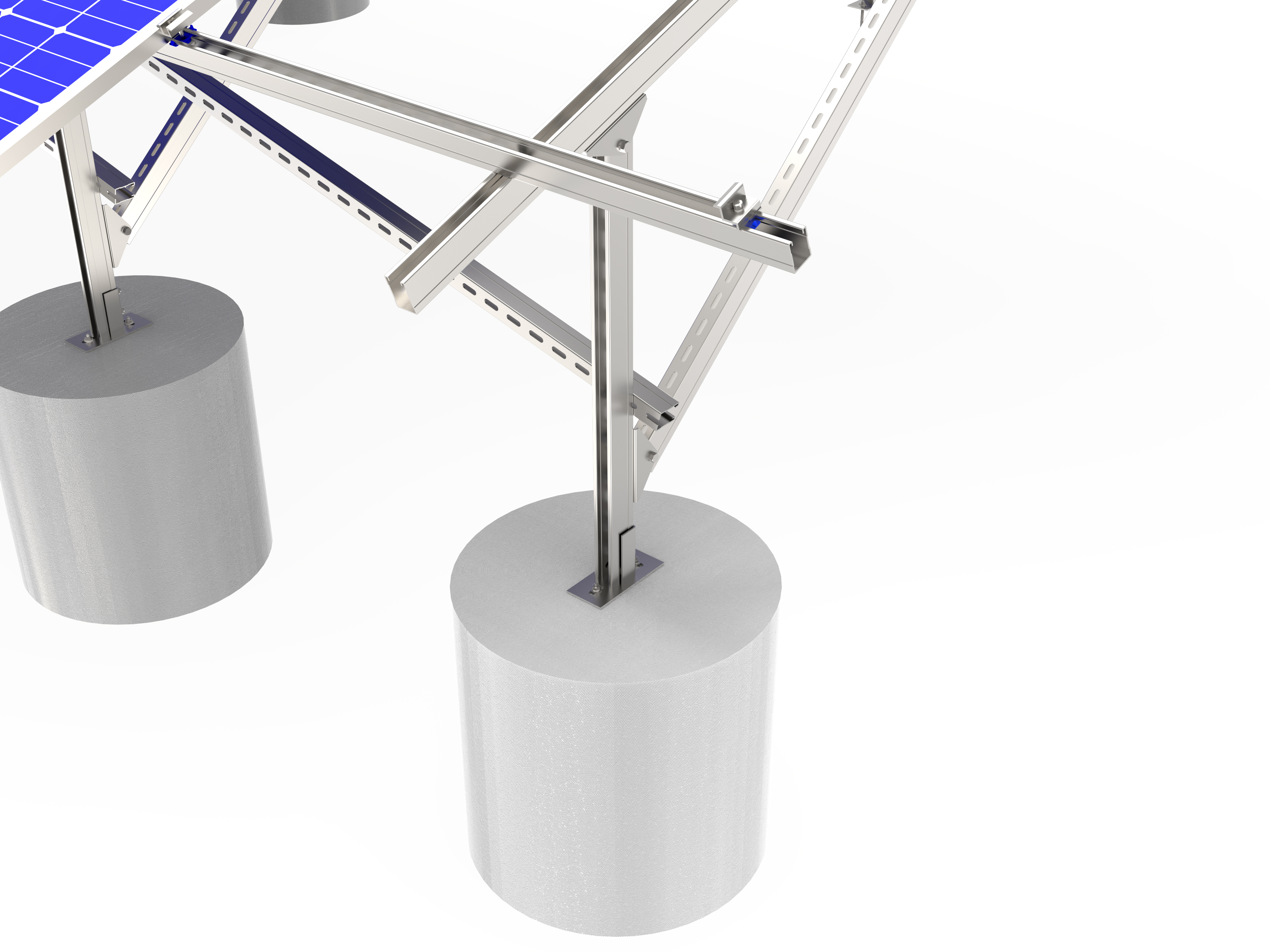
Installing solar panels on a flat roof is not the same as just drilling holes on a sloped roof, and installing solar panels on a flat roof is not finished just by drilling holes like it is on a sloped roof.A flat roof has a waterproof layer, and drilling on top of a flat roof is prone to water leakage.Ballasted systems secure solar panels on roofs using their own weight, (no drilling required).
How Solar Ballast Systems for Flat Roofs Work In short, place concrete blocks or steel counterweights on the installed brackets so that the entire solar panel array can be stably installed on the roof.You don't need to pierce the surface of the roof, the waterproof layer is still in good condition.
 Advantages
 No drilling operation was carried out, so there is no risk of leakage.
Quick installation. There is nothing complicated and rigidly fixed. Just place the panel in the correct position.
Does not affect roof warranties: Many roof manufacturers do not permit drilling, as it voids the warranty. Since
Solar Flat Roofs Ballast Systems do not require drilling, they do not affect the original warranty
Disadvantages Heavy weight: 30 to 60 kilograms of ballast per square meter is required. Before installation, a professional must inspect the roof to ensure it can support this weight
Caution required in high-wind areas: If your region experiences frequent typhoons or strong winds, relying solely on weight may not be sufficient, and additional reinforcement may be needed
Materials and Corrosion Resistance Flat roofs are prone to water accumulation, and for the materials used, corrosion resistance is very important.The ballast system has relatively high quality. It uses anodized aluminum alloy with an oxide layer thickness greater than or equal to 15 microns, or hot-dip galvanized steel with a coating thickness greater than or equal to 65 microns.All bolts and nuts are made of 304 or 316 stainless steel.If near coastal or relevant areas, 316 stainless steel is suggested.Low-cost electrogalvanized products are on the flat top, and they will rust after 2 to 3 years.
Key Installation Points Place an ethylene propylene diene monomer rubber gasket between the stent bottom and the roof membrane.This prevents the bracket from sliding, and the protective waterproof layer will not be scratched by the metal edge.There should be a sidewalk at least 60 centimeters wide left next to the system, for subsequent cleaning and maintenance.


